When you think of summer, the Arctic likely isn’t the first destination that comes to mind. Yet it’s one of the most captivating times of year to experience this land of extremes. Think golden-hued sunlight that makes midnight feel like mid-afternoon, late-night hikes, salty air sauna sessions and fjord landscapes carpeted in wildflowers.
This is why summer in the Arctic is one of travel’s most extraordinary experiences.
The midnight sun – a phenomenon worth travelling for


Lofoten: Shutterstock / biletskiyevgeniy.com. Lapland: Shutterstock / Anterovium.
For many, summer promises longer days and later evenings. In the Arctic Circle, this takes on a new meaning entirely. The midnight sun phenomenon means daylight lasts well into the night; the sun may dip to the horizon for a short twilight, but darkness never quite arrives. This presents all sorts of possibilities: think a round of golf at midnight, an 11pm hike, or a kayaking expedition when you’d usually be tucked up in your pyjamas. There’s a surreal quality to it all – the fishing villages, mountains and forests sparkle with liquid gold, far from the stark, snow-buried landscapes most people picture when they imagine this corner of the world.
Why summer is the Arctic’s best-kept secret
Forget the thermals: the Arctic summer is less about rugging up and hiding away than it is about being in the great outdoors. After the harshness of winter, the landscapes come to life; hiking trails, mountain passes and roads are accessible and the fjords can be explored by kayak. Wildlife is abundant, from sea eagles overhead to Icelandic puffins and reindeer ambling through the woodland of Lapland. And perhaps the best part? Far from the summer crowds of the Mediterranean, it feels like somewhere the rest of the world hasn’t discovered yet.
The Arctic experiences you can only have in summer


SkyView Igloo Resort, Rovaniemi. Source: supplied.
Sleeping in a glass-roofed igloo beneath a sky that never goes dark. Stepping out of a floating sauna into the warm evening air – no icy shock, no rush to get back inside. Kayaking calm, glassy fjords beneath jagged peaks, with sea eagles and nesting puffins for company. These are the experiences that define an Arctic summer – and that no other season can offer.
The unmissable destinations in the Arctic summer
Lofoten Islands, Norway


Lofoten: Shutterstock / beboy / LEOCHEN66.
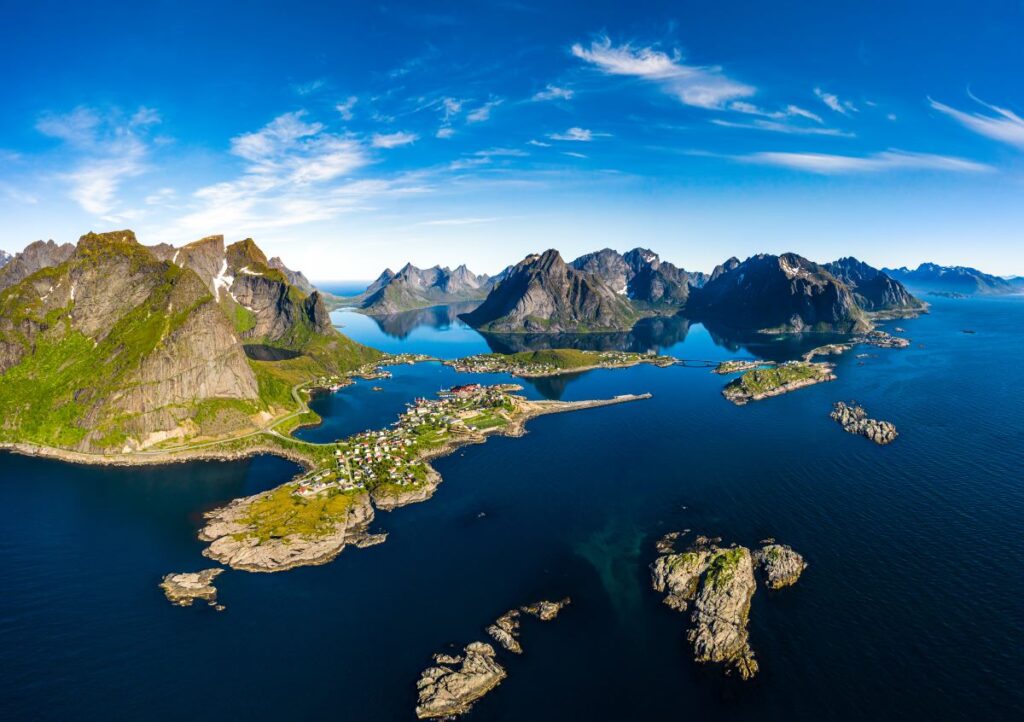
In Northern Norway, this island archipelago of fjords and soaring peaks is cinematic in its beauty. The landscape is dotted with charming waterside fishing villages like Reine and Ballstad, whose fishing heritage dates back to Viking times: all documented at the Lofotr Viking Museum. Take to the waters by boat or kayak, learn to surf, take a wildlife safari, play a round of golf, or even ride horseback through the waves. Few places on earth reward the outdoors obsessive quite so generously.
Finnish Lapland (Rovaniemi)


Rovaniemi: Shutterstock / Vidar Lennart Fredheim / Antti Hamalainen.
Finnish Lapland is a landscape of ancient forests, glassy rivers and reindeer that wander with complete indifference to your presence. The regional capital of Rovaniemi sits precisely on the Arctic Circle, making it ground zero for the midnight sun phenomenon: in high summer, the sun doesn’t set for weeks. Spend your days hiking forest trails, visiting a reindeer farm or exploring Arktikum, the region’s superb museum dedicated to Arctic culture. It’s quieter than Lapland’s winter incarnation, and all the better for it.
Iceland (Reykjavik & Golden Circle)


Reykjavik: Shutterstock / SCStock / Utemova Ekaterina.
Just south of the Arctic Circle, Iceland doesn’t do anything by halves. The capital, Reykjavik, is compact and walkable, its colourful streets lined with design studios and some of the North Atlantic’s most adventurous restaurants – think langoustine, Arctic char and, for the brave, fermented shark. But the real drama lies just beyond the city on the legendary Golden Circle, where tectonic plates pull apart at Þingvellir National Park, Strokkur geyser erupts on cue every few minutes and Gullfoss waterfall thunders into a canyon below. Summer adds a layer of surrealism: dine inside a working geothermal greenhouse where tomatoes grow year-round, or taste food literally cooked in the earth using volcanic heat. In winter, you’d be doing this in the dark. In summer, the light never leaves.
Stockholm


Stockholm: Shutterstock / Roxana Bashyrova / Mistervlad.
Strictly speaking, Stockholm sits well south of the Arctic Circle – but as a starting point for an Arctic summer journey, it’s hard to fault. Sweden’s capital is at its absolute best in July: long, warm evenings on the waterfront, the cobblestoned lanes of Gamla Stan glowing in the late light, and a dining scene that has spent the last decade quietly becoming one of Europe’s most exciting. It’s worth arriving a day or two early to absorb it – a visit to the Vasa Museum or dinner at a Michelin-starred restaurant sets the tone for the adventure ahead. Think of it less as a destination and more as an overture.
Everything you need to know about the Arctic in summer
Is the Arctic warm in summer?
Across the Scandinavian Arctic, summer temperatures typically range from 10°C to 20°C, with Lofoten and Finnish Lapland offering long, mild days ideal for hiking and kayaking. Iceland tends to be slightly cooler and windier, averaging around 10–14°C in July. The key is variability – layers are essential, and a light waterproof is always worth packing.
What should I pack for the Arctic in summer?
Think versatile layers rather than heavy gear. A lightweight down jacket, a waterproof outer layer and moisture-wicking base layers will cover most conditions. Comfortable walking shoes or trail runners are essential for hiking, while a pair of sandals will earn their place during warmer afternoons. Sunglasses and SPF are non-negotiable for the midnight sun. And if you’re planning on being out past midnight (you should be), a sleep mask will help when you eventually make it back to bed.
Feature image: Lofoten Islands. Source: Shutterstock / Andrei Armiagov.